In politics, there are no such things as certainties, and Green Party Conference 2023 is a great reminder not only of that. Looking at the agenda document ahead of the Green Party conference, there were several things that seemed to be certainties. One was that the motion to ban Greyhound Racing would surely sail through. Another was that the issue of HS2 was one of the most contentious issues on the order paper and there was no way to unite the party on this issue. But the changing tides at Brighton washed away both of those certainties as perfect examples of Green Party democracy in action.
Before the conference, I had been in a conversation about some who wanted to make sure that her proxy vote would be used to vote for the greyhound racing ban. While I understood her passion and sentiment, I struggled to explain why this was not necessary. There was no way this debate would go to a card vote. It would be a brave person to vote or speak against the idea that the Green Party should call for a ban on greyhound racing.
This was so much of a certainty that the press release was being prepared in advance, with the proposer being interviewed and photographs taken with her and her dogs outside the Brighton Centre. That made total sense. It would be one of the good news stories from conference, promoting the party’s stance on animal welfare, with some nice photos of beautiful animals thrown in. Whatever you think, this is exactly the sort of story the Green Party needs to break if it wants to set the narrative in the press.
And when it came to the debate, everything was going just fine, it was going to sail through.
But when it came to the debate, there was a brave person willing to speak against. Well sort of at least. He said that he didn’t want to speak against the motion, but point out an issue, a small and almost certainly unintended issue. The motion as it was written would delete the existing policy concerning horse racing, such as opposition to the use of the whip, and while it called for an end to animal exploitation for racing, it got rid of too much other good stuff.
The ban on greyhound racing had the support of the room, it had been one invigilator away from becoming policy. I don’t think anyone there will have seen a room change it’s mind so quickly, so completely, not to vote against the motion of course, but to refer it back, meaning the motion would have to be rewritten to avoid this unintended problem. The beauty of it was that this change of collective heart wasn’t down to some impassioned plea, but well-intentioned nitpicking, and this is something that truly sets the Green Party apart. Not only do most political parties minimise opportunities for the membership to set or question policy, but when they do, as soon as there had been an inkling that this might go the wrong way, a leading light of the party would have risen to give a speech filled with rhetoric and bluster to force the matter through on their coattails. After all, the press release was ready to go!
If what happened with Greyhound Racing seemed a shock, the idea that the conference would pass policy on HS2, pretty much unanimously in the space of ten minutes, without even having any debate would have left many observers on the floor, but that is exactly what happened.
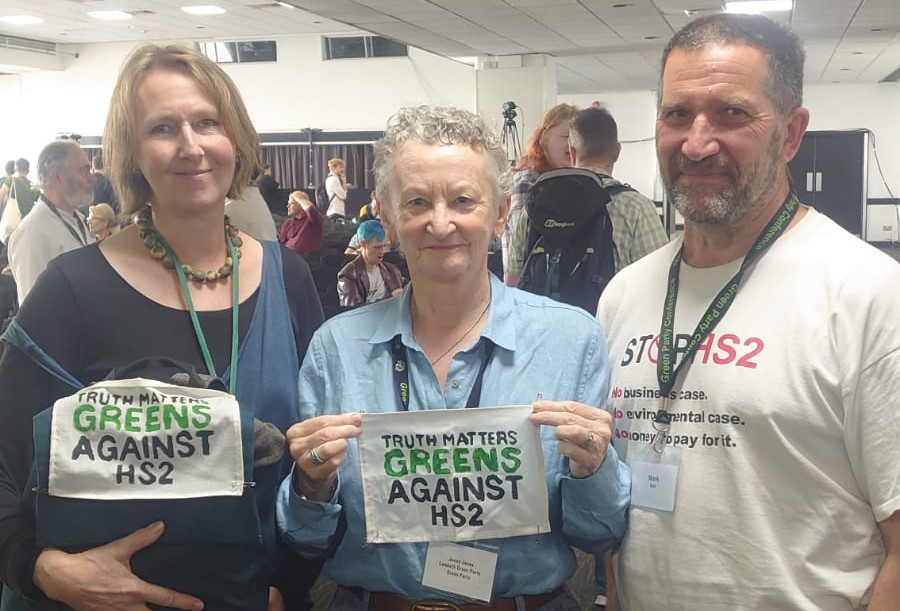
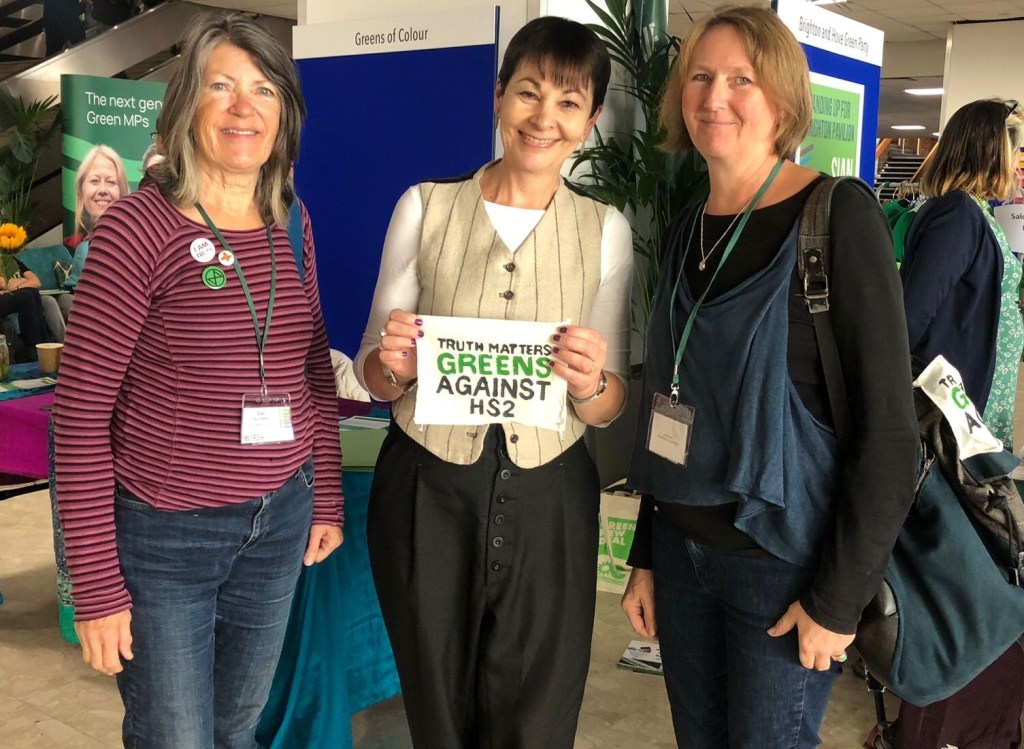
After falling off the agenda twice at spring conference, HS2 was up for debate again this time, with the motion “Fund HS2 and Northern Powerhouse Rail” resubmitted and rebranded as “Green Rail Strategy for the Midlands and the North” now being flanked by a completely opposite motion to “Reaffirm Opposition to HS2”.
These debates had been bundled together so they would be heard consecutively at a time when it had been impossible to escape the issue of HS2. The telephoto lens which had captured a treasury official with a document outlining the cost savings for cancelling parts of HS2 had meant that conference was happening in the perfect storm of HS2. Rishi Sunak had chosen to stick his fingers in his ears over the speculation for three weeks, because nothing was going to stop him announcing that HS2 would not get to Manchester, in a former railways station, in Manchester.
Many of the arguments that Sunak made for cancelling HS2 echoed the reasoning that saw the Green Party come out in opposition to HS2 back in 2011. He didn’t quite go as far as former GPEW Sustainable Development Spokesperson John Whitelegg did when he labelled the then £17bn London to Birmingham line as “Socially Regressive, Environmentally Damaging and Bafflingly Irrational”, but he did say that the project was too expensive and more benefits to more people could be delivered more quickly for less money by improving the local transport infrastructure. It’s not easy to admit a Tory might have got something right, but we at least had the solace of being able to disagree with some of the alternative projects he thought the money should go on. How anyone can think that the entire rail network does not need to be electrified with in-cab signalling installed – improvements which can be delivered with next to no cost to the natural environment – is beyond many of us. The main reason from Sunak for the cancellation of HS2 was the spiralling costs, which if you had been listening to the lobbyist-driven rhetoric in the media at the time, is all my fault! OK, it was very much a team effort, but the line was that the costs had of HS2 went up because of all these crusty environmentalists and selfish nimbies living in Tory constituencies, causing all these new mitigations and tunnels on Phase 1. While I can’t take all the credit for what is at least a seventy-five billion pound cost escalation on HS2, I was Stop HS2 Campaign Manager for over ten years (in a Conservative area which has heavily gone Green in that period), so on that logic I’ve got to be personally responsible for a couple of billion of that? At least a couple of hundred million, surely?
The reality is that the environmental mitigations on Phase 1 are so far over-stated and minimal. Many of us have always been convinced that many of the post-construction environmental plans will never happen against a backdrop of significant cost-driven cuts to the project, and those tunnels had to be added because HS2 was terribly designed in the outset. Two tunnels in the Chilterns AONB were joined together because the deep cutting between them was unsustainable, but the main additional tunnelling was added in West London, where the original hastily draw up and clearly impossible plan had been for an overland route through Ruislip and Ealing.
The cancellation Phase 2 of HS2 was a missed opportunity for the Green Party, as without a policy debate due the same week, it would have been another opportunity for another massive dollop of “We told you so”, as the party could have drafted statements along the lines of “Well, it looks like we were right about this mess all along, what exactly did you expect? Maybe next time you should listen to us?”
While it is odd that the lobby to try and change the Green Party policy to support HS2 coincided with the widespread removal of habitats, the formation of protection camps and the considered opinion of wildlife NGOs that the environmental destruction is far greater than what HS2 Ltd have admitted, the reasons for debate on HS2 now are the same as they were when the policy to oppose the project was first passed in 2011. It is naturally hard for many in the Green Party to accept that any railway could be a bad thing, though unlike some of the people you will find on social media, there is surely no-one in the party itself who believes the implication of Green Party policy being anti-HS2, means that the party is somehow pro-road?
The costs of HS2 have gone up so uncontrollably for two reasons, complete mismanagement and corporate greed. Arguably these are one self-perpetuating and circular reason, as the more incompetent and ineffectual management is, the easier it is for construction companies, those whose lobbyists have been blaming residents and environmentalists others for the billions in cost over-runs they have been pocketing, to keep gold-plating HS2 and charging more and more for every job. Up until now they have been getting away with it, despite report after report showing HS2 was in trouble – most recently “unachievable” -, whistleblowers saying there was a deliberate agenda to hide true costs, and official minutes showing ministers knew this.
Until another vote on HS2 happens, no-one will know the size of the divide in the party on HS2 is, but there is clearly a divide, and many thought it would be impossible to unite the party on this issue. But there was something that everyone can agree on, and that is that what has happened with HS2 is quite simply a national scandal. Because whether you are ready to queue up for a ticket already, or you think HS2 should be buried deeper than the tunnels in the Chilterns, it impossible to disagree that what has happened to get the HS2 project to this point is the most godawful utter mess imaginable.
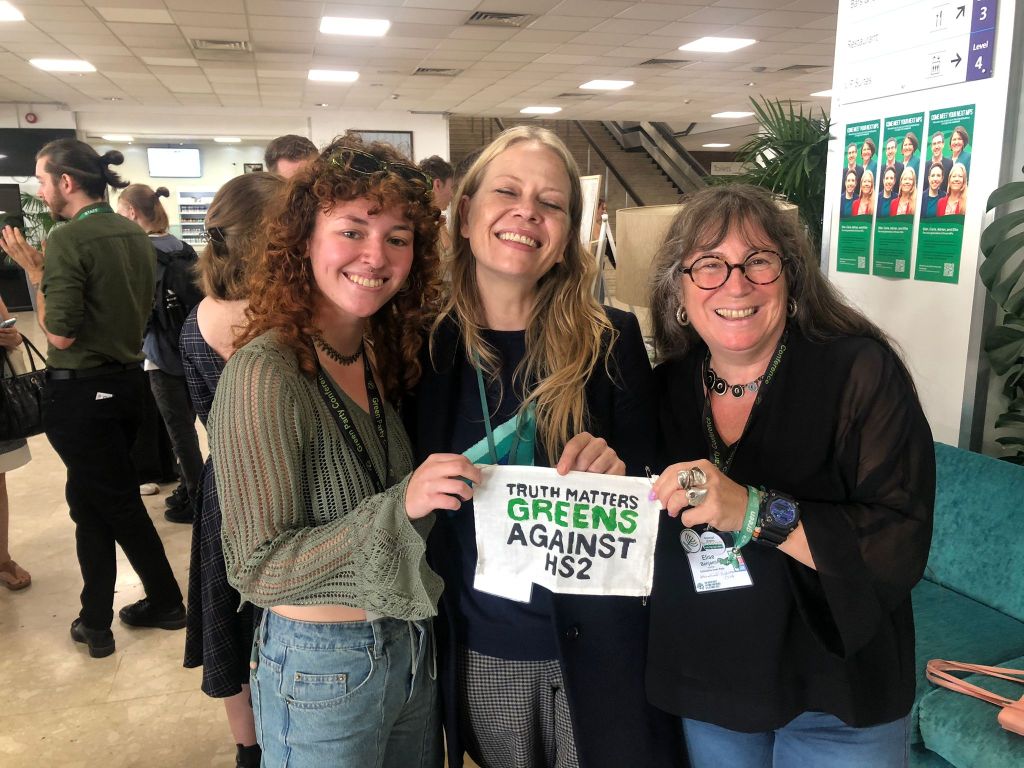
And you know what? We could all do with a bit of agreement on HS2, so an emergency motion was written to do the impossible and unite the Green Party on HS2, asking our parliamentary representatives to call for a public inquiry and a full-scale fraud investigation into this national scandal. And this time, there was time to discuss that emergency motion, in fact time was created to discuss it, with an extra ten minutes added to conference for a discussion. I say discussion, but there was no discussion, it was a high-speed motion dragging a high-speed amendment behind it. The amendment removed the call for a fraud inquiry, which given the Sunday Times splash since may have been shortsighted, but I have told one of our parliamentary representatives that she might still want to call for a fraud investigation anyway!
The other part of the amendment was to specify some of the things the inquiry should focus on. One of these was selling off the land – which legally has to be in the first instance to the people who owned it originally – which had already been bought for Phase 2. Noting that nowhere near all of the land needed had been bought, this was ostensibly a pro-HS2 amendment, but it wasn’t a big enough hill to let the whole motion die on, so it was accepted as friendly, especially as any form of debate would have run the motion out of time.
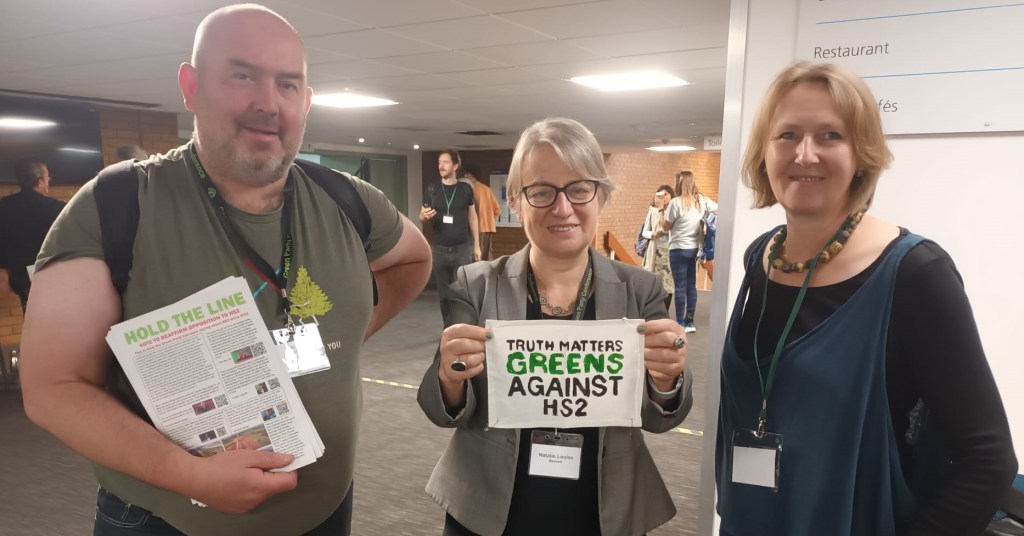
And not only did the motion go through without any debate, without anyone speaking against, save a question to ask if the fraud investigation could be put back into the text, but it went through in time and it gave the opportunity to show that compromise is possible, even when an issue seems unsurmountable, there can always be a way to find common ground in the Green Party. More than that, it provided a much needed end of conference lift, and everyone left a little bit happier. And although it might not have been the one that was intended, there was even the opportunity to send out one last press release!
e had initially hoped that the motion would have been heard at the end of Saturday and would therefore set the scene for the main debate the next day. The motion was specifically designed to be critical of HS2. Not the project, but the way it has been run, which it was felt would be something positive that even people who were for HS2 would admit and agree with
And not only did the motion go through without any debate, without anyone speaking against, save a question to ask if the fraud investigation could be put back into the text, but it went through in time and it gave the opportunity to show that compromise is possible, even when an issue seems unsurmountable, there can always be a way to find common ground in the Green Party. More than that, it provided a much needed end of conference lift, and everyone left a little bit happier. And although it might not have been the one that was intended, there was even the opportunity to send out one last press release!
e had initially hoped that the motion would have been heard at the end of Saturday and would therefore set the scene for the main debate the next day. The motion was specifically designed to be critical of HS2. Not the project, but the way it has been run, which it was felt would be something positive that even people who were for HS2 would admit and agree with.

 Greens Against HS2