The quick version is that it is being said the Green Party has changed position to support HS2. It hasn’t. That was certainly the intention from some, but at the conference the original motion was amended. Amendment 1 deleted the bit that said “The Green Party calls for the government to fund and build HS2 including the entire Eastern leg to Leeds”. That was the bit which would have changed GPEW policy to one of support for HS2, but it was deleted and in went a series of specific contingent conditions in line with “Green Values” which the delivery of HS2 has to align to (see below) . It doesn’t and handily, a Panorama investigation has come along just at the right time to provide evidence against the fourth criteria. Given this, the press statements saying GPEW has changed position to one to support HS2 are just simply wrong. Click here for the text of the motion as amended.
End the misrepresentation of conference policy on HS2.
Following the passing of Motion E01”Green Rail Strategy for the Midlands and the North”, press releases have been issued by the GPEW and posts published on websites and social media, which include quotes from the leadership stating that the Green Party has changed position on HS2, to one of support for the project.
This is not the case. Amendment 1 deleted the text which would have changed policy: “The Green Party calls for the government to fund and build HS2 including the entire Eastern leg to Leeds”. Motion E01 as amended now sets down four contingent conditions in line with Green values which Green Party support for HS2 is dependent upon. These conditions have not been met, and there is no evidence they have ever been assessed. It also appears to be the case that there are no understood procedures for how these contingent conditions would be assessed in the future.
The relevant text in the motion reads:
“The Party’s support for high speed rail in practice is nonetheless contingent on its delivery aligning with Green values. Specifically, these values will necessitate:
· Proper timely data releases relating to the ongoing impacts of HS2, using up to date biodiversity metrics and not excluding any habitats;
· Limiting adverse impacts on biodiversity and bioabundance, and, where adverse impacts are unavoidable, securing a 10% biodiversity net gain within the development site;
· Independent monitoring of impacts and remediation schemes; and
· Proper compensation for those affected by the scheme’s construction.”,
As many of the speakers for the motion, and the subsequent press statements have pointed out, delivery of the high speed rail project HS2 is in process and there is no evidence that this delivery aligns with Green values and the specifics listed. To state at this point in time that the Green Party supports HS2 is to state that HS2 is being delivered in line with Green values, despite these tests not having been passed.
This is not the case. As such it is clear that the statements that the Green Party has changed position to support HS2 is erroneous and due to a misinterpretation of the policy which was actually passed at conference.
As such, the Green Party leadership and press office must retract these previous statements and clarify to all parties that the Green Party has not changed position to support HS2, but has simply laid down the contingent conditions on which support for HS2 is dependent. As these are contingent conditions, the Green Party clearly remains opposed to HS2 until these contingent conditions are met. To say otherwise at this point in time would be a misrepresentation of the policy passed at conference.
Up until now, it is likely that this misrepresentation of the actual policy which was passed has been accidental, and due to an incorrect interpretation of how Amendment 1 impacted the substantive of the motion. Now this error has been pointed out, to continue to make such statements would be a deliberate act to incorrectly interpret the policy as set down by Conference. This would not align with Green values and would damage the reputation and credibility of the Party.
Given that there have already been a number of resignations from the Party of members and councillors due to the misrepresentation of the policy as was passed, this action must be taken immediately.
If your local Green Party does not agree with what has happened following the Manchester Conference, you may want to consider passing this, of a policy similar to this at your local party. If you do do that. don’t forget to let us, and the national party know!
Following Green party Conference 2024 in Manchester [YOUR LOCAL] Green Party wishes to reaffirm opposition to the construction of HS2.
We regard HS2 as a figment of a politically corrupt and inept system that provides no valid oversight or regulation and is effectively a means to the end of perpetually increasing GDP (as evidenced by the government’s reference to HS2 as an “Engine for Growth1”).
Furthermore, we regard HS2 Ltd as a desperately mismanaged corporation, both financially and ecologically inept and wholly unaware of their responsibilities to the British public and tax payer, and wholly unaware of the rationale behind high speed rail.
We regard the HS2 project as a disastrous ecocidal rampage of an unchecked, unregulated and out of control construction industry. Their actions are mirrored in so many other areas such as: cladding of residential properties; crumbling schools and hospitals; and rampant road expansion amongst other things.
We are also seriously concerned that following the conference, statements were issued by the party in the press and social media claiming that the GPEW had reversed policy on HS2. We believe the original motion which attempted to change policy on HS2 was utterly unevidenced and created by a sad introduction of dishonesty that stains the Green Party.
However, the motion in question was amended, meaning that GPEW support for HS2 was contingent of the delivery of the project meeting Green values; specifically:
· Proper timely data releases relating to the ongoing impacts of HS2, using up to date biodiversity metrics and not excluding any habitats; · Limiting adverse impacts on biodiversity and bioabundance, and, where adverse impacts are unavoidable, securing a 10% biodiversity net gain within the development site; · Independent monitoring of impacts and remediation schemes; and · Proper compensation for those affected by the scheme’s construction.”,
We believe that none of these contingent conditions have even been assessed, let alone met, and as such the Green Party remains in opposition to HS2, and that the GPEW leadership must immediately issue a clarification on this point, that E01 as passed as conference does not change the policy of GPEW to one of support for HS2, it merely sets down the criteria on which support for the project may be granted in the future. We simply do not understand why statements have been issued stating GPEW now supports HS2, when this is not what the policy says.
As such, until such time passes as these contingent conditions are verifiably passed and it is confirmed that HS2 aligns with Green Values, then the GPEW clearly remains opposed to HS2. We further believe that given the history of HS2, it is highly unlikely that these tests will ever be passed.
We believe, that this is in part due to the fact that the original GPEW policies of opposition to HS2 were extremely well evidenced, and that evidence provided by relevant NGOs aligns very closely with previous policies, and these NGOs provide the clearest evidence that the criteria in the tests set down by conference continue to be failed. We believe also that many members of the party have continued to collect and collate evidence since then which shows HS2 to be even further away from Green Values than we initially feared.
In closing, our opposition to HS2 remains undimmed. We will wholeheartedly continue to both resist the project and publicise its ineptitudes, mistakes and crimes against nature and people. We will demonstrate our opposition within the national party at every relevant opportunity, and we reiterate our call for the GPEW leadership, press office and any other relevant bodies to immediately issue a retraction regarding any and all statements that the Green Party now supports HS2, and clarify the actual policy, that HS2 will only be supported if it meets with Green Values.
So there we go, the conference is over, the vote has happened, we lost. The pro-HS2 motion, originally called “Fully fund HS2 and NPR”, now rebranded as “Green Rail Strategy for the Midlands and the North” went through, by 345 votes to 318. The Green Party now supports HS2.
Or does it?
Because the thing is, the motion passed at conference was so badly written that as far as we can see, the Green Party hasn’t actually changed policy on HS2 yet. It’s just that people who clearly haven’t read or understood the policy (namely the people who wrote and supported it) have decided that is what it means.
The synopsis of the original motion may say “This motion calls for HS2 to be funded and completed in full”, but the text of the motion which actually states that as a policy position was removed by conference. Specifically, the text: “The Green Party calls for the government to fund and build HS2 including the entire Eastern leg to Leeds” was the bit which would have changed GPEW policy to one of support for HS2, but it was deleted. It wasn’t in the final motion as passed. from the motion by Amendment 1. The amended policy as passed by conference can be found here.
It is a matter of fact that at the pre-conference workshops, more people voted for the motion with the amendments than did without and many people at the conference said they had been turned by the amendments. Additionally the Amendment 1 added these contingent conditions which need to be met for the party to support HS2:
“The Party’s support for high speed rail in practice is nonetheless contingent on its delivery aligning with Green values. Specifically, these values will necessitate:
· Proper timely data releases relating to the ongoing impacts of HS2, using up to date biodiversity metrics and not excluding any habitats;
· Limiting adverse impacts on biodiversity and bioabundance, and, where adverse impacts are unavoidable, securing a 10% biodiversity net gain within the development site;
· Independent monitoring of impacts and remediation schemes; and
· Proper compensation for those affected by the scheme’s construction.”,
Well, delivery is underway and on all of those measures, HS2 has already failed. This policy is absolute on this issue, that GPEW support for HS2 depends of four contingent tests being met, and there is no evidence that these contingent tests have even been assessed, let alone passed. So to say GPEW supports HS2 is most certainly not aligning with Green Values. With this amendment accepted, the policy sets down the grounds on which HS2 would be supported by the Green Party. It does not mean the Green Party supports HS2, and the dictionary backs us up on this one!
To be absolutely clear, as far as we can see, the policy which was passed means the Green Party hasn’t actually changed its stance on HS2 yet. To say that GPEW has is a selective and quite possibly illegal (we’ll get back to you on that one) reading of the policy.
So there is no evidence there has been any attempt to assess these issues, let alone prove them. And if this was done, who would be the arbiter? Handily, a Panorama investigation has come along just at the right time to provide evidence against the fourth criteria. One of the speakers for the motion said the other points had been put in specifically because of the Wildlife Trusts reports on HS2. We are unaware that anything has changed since their 2023 report.
But who gets to judge this? Where is the evidence that these tests have been applied? These questions remain unanswered, and until they satisfactorily are, GPEW surely remains in opposition to HS2, unless we are to pick and choose which words count from this policy?
This is what the policy says. Support is contingent on specific tests being met. They haven’t been. It’s that simple. It seems the proposers of this policy didn’t bother to pay attention to what all of the words actually meant. They seem to have assumed that they could get the policy through, that would mean GPEW automatically supports HS2, and they can sort out how exactly the conditions for that support are measured afterwards!
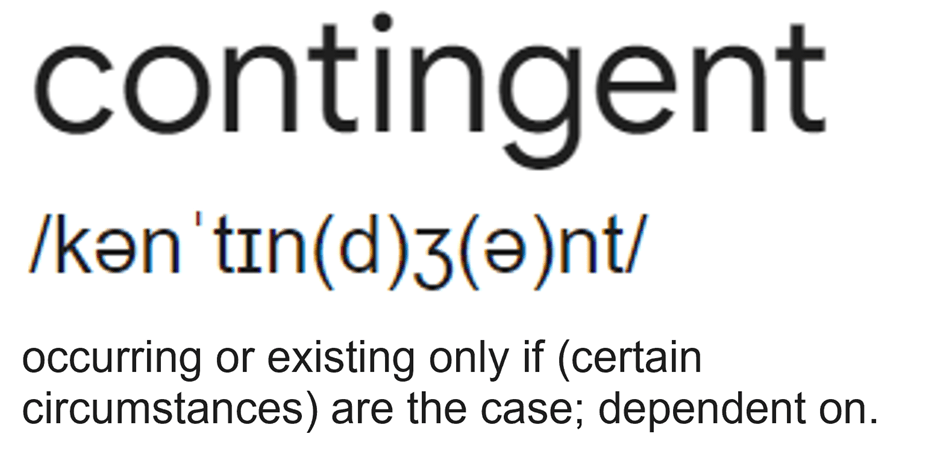
No, that’s not how this works! the word you put in the policy was “contingent”, meaning “dependent on”, meaning GPEW support for HS2 is dependent on these undefined tests being met.
So anyone reading this might want to point that out to various people within the party, ask questions and the like and maybe come back to this site on Tuesday, after the Panorama has broadcast on BBC1. Maybe you want to be on social media about that, but we think that is more going to be about the scandal of intense lobbying for HS2 aimed at ensuring the symphonising off of billions of taxpayers pounds into the construction industry.
But then again, what would the Green Party know about a scandal of intense lobbying for HS2 aimed at ensuring the symphonising off of billions of taxpayers pounds into the construction industry?
That is part of the “what now?” conversations which have been going on following the fact that we lost the vote on Sunday. The other saving grace is that even if GPEW did support HS2, as Natalie Bennett who spoke against HS2 has already pointed out, being a non-whipped party, you don’t have to. She certainly won’t be doing! You can see her being interviewed directly after the vote here.
EXCLUSIVE: “I will not personally be speaking in favour of HS2.” – @TheGreenParty peer Baroness @natalieben responds to controversial vote at #GPC24 on #HS2 which reverses long standing Green Party opposition to HS2, effectively splitting the party on the issue. pic.twitter.com/eDruJ3JQDh
The vote on E01 on conference floor came out 287 for and 226 against, and while after going to a card vote, those proxies did narrow the gap to 345 to 318, it was not enough. There were calls from Bennet and acting convenor of the Transport Group Jeremy Drew (online) to hold a procedural motion to refer the motion back as there are several issues in it which contradict existing policies, but this was not allowed by the chair.
And it’s clear this motion should have been referred back, not just because we are now in a position where we have a policy which cannot be enacted because it is contingent on conditions being met without any idea of how those conditions would be assessed or who would assess them, and also not just as you’d expect we’d say that it wrecks the credibility of the Green Party after a decade of standing up against the corporate lobby and a lifetime of standing up for nature, but because it is just a terrible policy and writes off the idea that the Green Party is evidence-based.
“The Green Party has long supported the principle of a new north-south high-speed rail line but had serious concerns about the specific route of HS2 and the environmental impacts of this route. However, this first phase of HS2 between London and Birmingham is well under way and most of the environmental impacts of construction are already baked in. So this is a pragmatic decision by the Green Party. It moves us on. Crucially, we have also acknowledged that the northern leg of HS2 was always the most important in terms of tackling capacity issues on our railways as well as addressing regional inequalities. So the line must be completed in full. We also say loud and clear that our railways have to be built right – for habitats and wildlife, for local transport users, for affected neighbours and for government coffers. Greens will not support blank cheques or offer uncritical endorsement. We need to move at great speed to shift travel away from cars and flights to public transport. HS2, in full, can play an important role in achieving this shift.”
Fundamentally, there are so many errors in that statement. Firstly, Phase 2 of HS2 is far longer than Phase 1 of HS2. Also to get through London, Birmingham and under the Chilterns AONB means there are far more tunnels on Phase 1, so only about a third of the environmental impacts of construction are already ‘baked in’. It is also the case that not all of the damage has even been done on Phase 1 yet. For example, Roughknowles Wood in Kenilworth which is due to have Cryfield Grange Road diverted through it still stands. In terms of capacity (not that HS2 delivers anything like the capacity uplift being claimed) HS2 itself hardly delivers any additional capacity at all in the North of England (though NPR would). Every element of the rhetoric that ‘railways have to be built right’ is completely counterfactual when you look at how HS2 Ltd have acted over the last 14 years, and as for not supporting blank cheques or offering uncritical endorsement – that’s exactly what we have just done! Since 2010, dozens of politicians have said there will be no blank cheque for HS2, but they never stop supporting it when the cost goes up. As for NPR, there is no official cost – this is the very definition of a blank cheque! And concerning that modal shift argument….
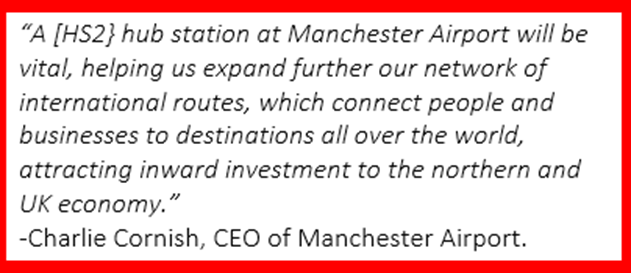
As has been said on numerous occasions, HS2 does not go to airports to discourage people from going to airports! We simply cannot understand how supporters of HS2 ignore the fact that bosses at both Birmingham and Manchester Airports have gone on public record saying they see HS2 as essential to expanding their international routes. And if HS2 was really intended to take flights out of the air, it would connect with HS1 and the Channel Tunnel, instead of stopping half a mile short at the wrong London station. Well, if it even gets that far……
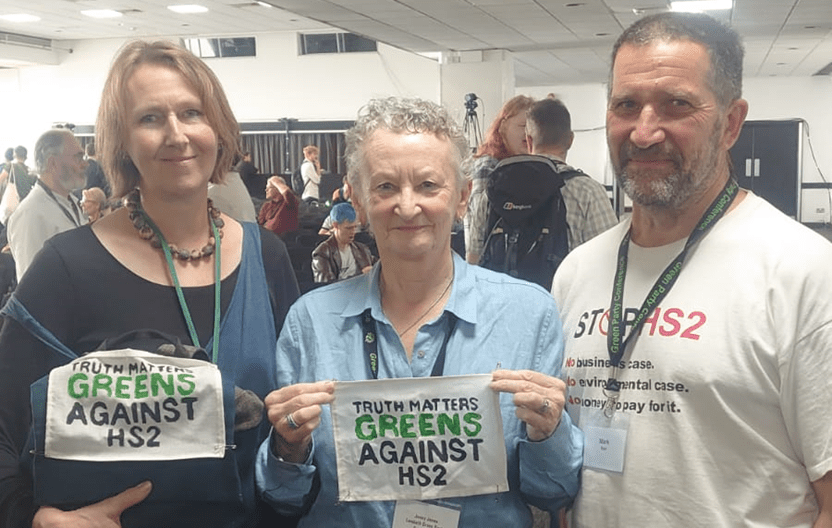
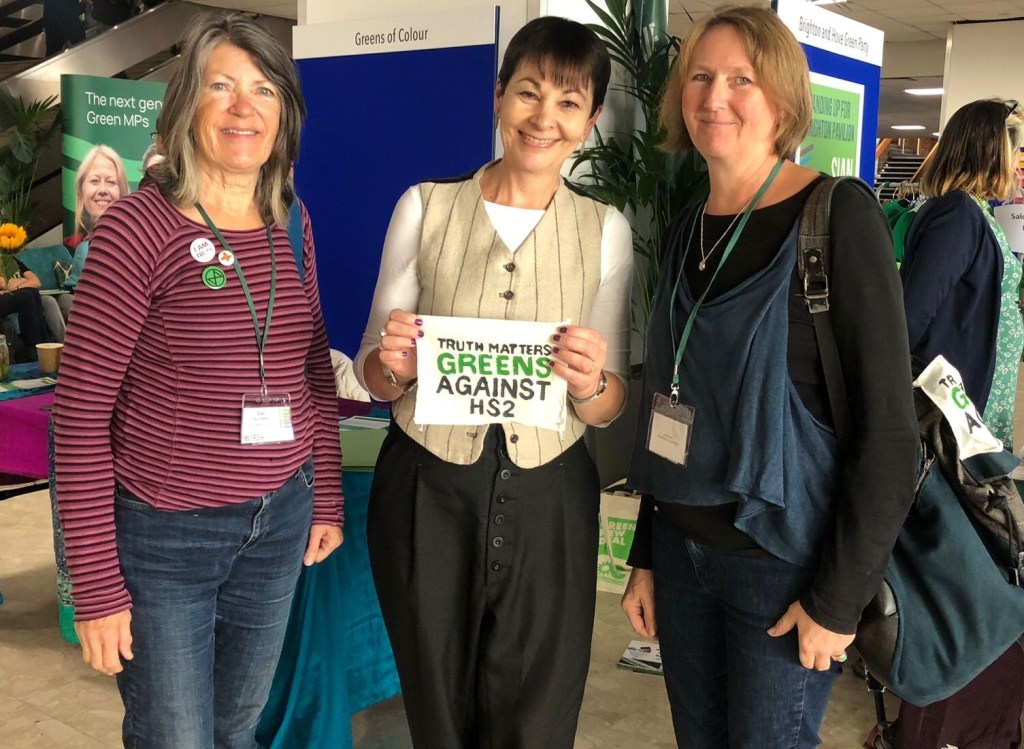
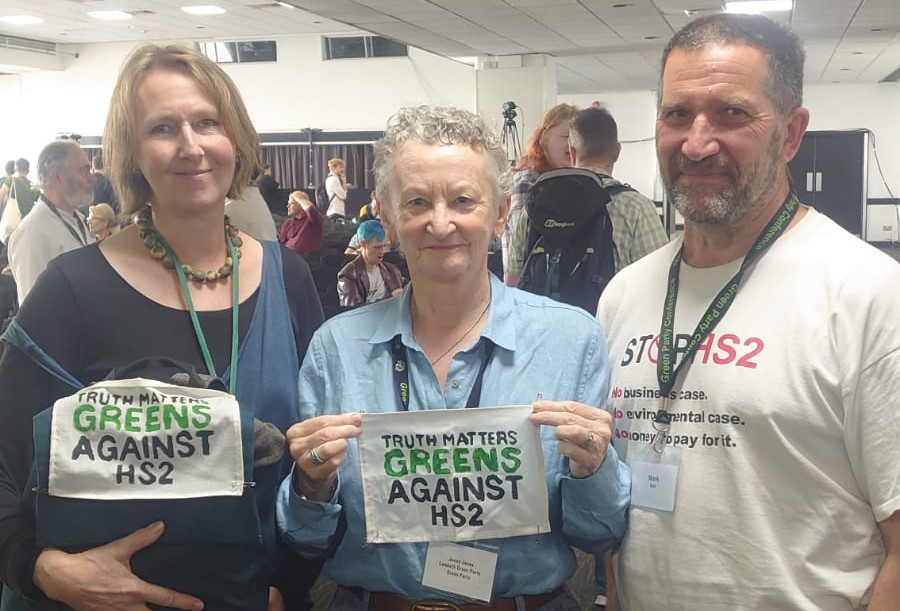
As for making pragmatic decisions and moving on, first to do that was Mark Keir (pictured with Juliet Carter and Baroness Jenny Jones) who spoke against the motion and actually managed to resign from the Green Party before the conference had closed. There have been several more since that we know of, and many still considering the position and their next steps.
Mark stood for the Green Party in the Uxbridge constituency against Boris Johnson in 2017, an election he has repeatedly apologised for not winning. He was also labelled “Crazy Anti-HS2 Campaigner of the Week, Number 35” by Paul Bigland, the originator of the pro-HS2 social media tactic of “Dogpile and Bully”, an individual who disturbingly some in the Green Party are treating as a credible source of information.
Amongst many other actions against the unnecessary destruction of the environment carried out by HS2 Ltd, along with camps at Jones Hill Woods (the Roald Dahl one) and Colne Valley, Mark had been involved in the longest ever underground environmental protection action ever seen in the UK – lasting 46 days – one of three HS2 actions that saw environmental protectors underground for over a month. This protest was against the destruction of Bluebell Wood (below) in Swynnerton, an area where HS2 Ltd were going to go ahead with removing woodland habitats despite that section of the line not having been approved. As that section of HS2 has now been cancelled, these precious habitats have been saved. You have to understand that changing Green Party policy is telling nature defenders that they were wrong, that we have turned our back on them and if he were to go back into those tunnels he would be wrong to do so, because the Green Party have just passed policy which demand that this and many woodlands like it are destroyed by a railway which due to excessive proposed speeds, has been designed in a way which maximises environmental damage, and then as Mark and many others have seen in practice, built by construction firms who carry out far greater environmental damage than there was supposed to be.
Given this, we’re shocked that people are shocked that people are resigning over this issue. The Green Party has already lost control Stroud Town Council, which is nowhere near the route of HS2, due to resignations over this policy.
If you are thinking of quitting, scaling back or reducing the money you donate to the Green Party, let us know. We know there are many considering their position, submitting motions at local party level, and waiting to see if GPEW will retract press statements made in support for HS2, and clarify that support for HS2 is contingent on certain tests being met.
There were thousands of people, many of whom were GP members in the protection camps, some of whom joined the GPEW because of opposition to HS2 as the “political wing of the environmental movement”, a title the party no longer has any claim to. They are the ones who have seen the reality of HS2, unlike some who claim being schmoozed by HS2 Ltd and shown what they wanted you to see somehow counts as an objective assessment.
How did they not see how such committed environmentalists would take this as an act of utter betrayal? It would be politically naïve not to do so. To claim a vote of 345 to 318 “moves us on”? Well being politically naïve is the best case scenario, as the other is knowing this would cause a self-purge of such people and being OK with that. And shamefully, several of the responses we are seeing on social media are very much OK with that.
But that is what this sort of campaign is about, it’s about showing masses of support on social media. All these vocal people, this whole mass movement, and the other side they’ve got no-one, no signs of support, maybe because like aforementioned Joe Rukin, he’s basically been bullied off social media by the pro-HS2 lobby. Just see some of the response to this tweet. Are they in line with “Green Party Values”? [POST PUBLICATION EDIT – well maybe new replies might be after we called them out, but they know who they are! Next time, we’ll screenshot!]
With great regret, having been a paid up member in good standing for at least 10 years, I’m now resigning from @TheGreenParty due to the majority voting for HS2. I cannot support desecration of woodlands for capitalism. pic.twitter.com/fsscU6vFrS
The thing is, the actual vote was 345 to 318, and it needed the support of the Party co-leader to get there, and so much of the policy which has been passed is just plain wrong. Not ideologically wrong, but factually wrong.
The Green Party now claims supporting HS2 would be in line with the strategy to reduce urban sprawl, despite the fact that large areas around Lichfield, Solihull, Coventry, Brackley, Aylesbury and the Colne Valley Park in London which were protected green belt are now along with dozens of more rural sites brownfield, and ripe for development.
The Green Party now claims supporting HS2 would be in line with the strategy to reduce carbon emissions, an argument which completely ignores massive carbon output caused by building HS2, with none of the three the official forecasts predicting carbon neutrality on a 120 year forecast.
The Green Party now claims support for HS2 could dramatically reduce rail fares due to higher capacity, despite the fact that HS2 will never make a profit and require a massive ongoing subsidy forever.
The Green Party now claims that HS2 would benefit communities in north and mid-Wales (Amendment 2), whilst claiming at the same time that HS2 is an England-only project (Amendment 3)!
And that’s the thing. This is not just about HS2, but this is an absolutely terrible policy which has not been scrutinised and lacks research on several levels, meaning the Green Party is now effectively endorsing one of the bodies whose profit-before-professionalism attitude helped bring us Grenfell.
The motion as passed the Conference states more than once that “Positive environmental outcomes will be delivered by each of the stations achieving a BREEAM status of excellent or better.”. ‘BREEAM stands for “Building Research Establishment Environmental Assessment Methodology” administered by the Building Research Establishment (BRE).
As a result, the Green Party has now advocates BRE as the arbiter of environmental standards in building, a company heavily implicated in the Grenfell disaster. It’s not that the proposers couldn’t have known this as the final report was produced just days before conference, it was revealed in 2022 that BRE had conducted a test of the Grenfell cladding which it had “failed spectacularly”. In the final Grenfell report published days before conference, the Inquiry found:
“Much of the work carried out by BRE was marred by unprofessional conduct, inadequate practices, a lack of effective oversight, poor reporting and a lack of scientific rigour. In some cases we saw evidence of a desire to accommodate existing customers at the expense of maintaining the rigour of its processes.”
So anyone who has had to deal with HS2 Ltd in the past knows they will fit right in.
But in some ways the commitment to Northern Powerhouse Rail is worse than the one to HS2. Of course we are for rail investment in the North of England, many of us are saying this is what should have been prioritised to start off with. But we don’t actually know what NPR is. There are some concepts, Transport for the North have got a lovely video, and some documents with suggested options and maps, but the last Government said in March they had only got as far working on developing a route between Liverpool and Manchester. So we don’t know what NPR will be. We don’t know the route, we don’t know the cost, and we certainly don’t know what the environment impact will be. But whatever those things are, we now want them. That’s not evidence-based policy. Instead of stating in policy that we want better rail links across the North of England (or dare we say it, in the whole country?), the Green Party has thrown it’s weight behind a slogan, and we will now live and die on that slogan, no matter what that slogan turns out to represent.
This is how political lobbyists operate. The same way an imaginary version of HS2 has been invented and lobbied for to get a policy through GPEW conference which can be distilled into “Green Party support for HS2”. The thing is this is what always happens, In 2006 the Eddington Transport Study for the DfT stated:
“The risk is that transport policy can become the pursuit of icons. Almost invariably such projects – ‘grands projets’ – develop real momentum, driven by strong lobbying. The momentum can make such projects difficult – and unpopular – to stop, even when the benefit/cost equation does not stack up, or the environmental and landscape impacts are unacceptable. The resources absorbed by such projects could often be much better used elsewhere.”
That was what happened with HS2 and that is now what is happening with NPR. The Green Party has never been lobbied in the way we have seen in the last few years over HS2 and NPR. But now, basically whatever NPR ends up being, it must be environmentally sound, because the Green Party already support it. The construction industry have tried to turn the Green Party into their apologists and lobbyists, and the moment the job is done. Now they move on, and a couple of days after the conference social media accounts for both Labour4HS2 and LibDems4HS2 were set up less than four hours apart. It might not be of surprise to see so many of the people who were involved with Greens4HS2 getting on board. So it seems for many people, the HS2 bit is more important that the political party they are allied to. But why on Earth would people be more interested in this multi-billion pound project than their supposed political principles……..?
We launch the Labour4HS2 account.
A base for Labour members to support the completion of the High Speed Rail 2 project, in a way that is reduces as much harm to the environment as possible.
We need better connectivity in Britain and, we deserve for it to be cheaper. #HS2
So here we are. The idea was meant to be that no-one could ever criticise the environmental credentials of HS2 again, because the Green Party were meant to have seen the devastation and destruction and agreed with it, but that agreement turns out to be conitingent…..
We’ve now got a few actions we’d like to to take, which you can see at the top of the page.
Whilst it has been said that the Green party has now changed it’s stance on HS2 to one of support for the project, this does not actually seem to be the case due to amendments making that support contingent on factors which have not been met, and quite frankly we’re not sure they can ever be met. The motion and the three amendments as voted on at conference are available via this link, but for clarity members of the Coventry Green party have kindly done all the ‘insert’ ‘add’ ‘delete’ and ‘replace’ work, and this is what you end up with as the ACTUAL policy. We’ve highlighted the part in question.
The Green Party recognises that transport pollution remains stubbornly high, and that there is a need to reduce transport demand to sustainable levels. In tandem, there is a simultaneous need to make the greenest modes of transport the easiest and cheapest modes of transport. This necessitates a transformative transition away from polluting modes such as cars and planes towards efficient, electrified public transport. This is consistent with the Party’s strategy to reduce: use of materials, batteries, chemicals and fuels; carbon emissions; air/particulate pollution; noise pollution; urban sprawl; land take from biofuel production; poor public health; and road deaths of adults, children and wildlife.
Accordingly, the Green Party supports high speed rail in principle. The Party recognises that high speed rail lines free up capacity on other rail lines that serve regional and local rail services allowing for more frequent trains to run on these lines. High speed rail lines themselves reduce domestic flights and car journeys for long distance travel because they can better compete for shorter journey times. The uplift in passenger capacity also provides an opportunity to dramatically reduce rail fares.
The Party’s support for high speed rail in practice is nonetheless contingent on its delivery aligning with Green values.
Specifically, these values will necessitate: · Proper timely data releases relating to the ongoing impacts of HS2, using up to date biodiversity metrics and not excluding any habitats; · Limiting adverse impacts on biodiversity and bioabundance, and, where adverse impacts are unavoidable, securing a 10% biodiversity net gain within the development site; · Independent monitoring of impacts and remediation schemes; and · Proper compensation for those affected by the scheme’s construction.
The Green Party calls for a local transport revolution to be implemented upon the completion of HS2 and the resultant uplift in rail capacity. This capacity should be used by transferring intercity expresses from the existing railway network to HS2, and then utilising the newly freed-up space for new local services to, in and around towns and cities across England and Wales. Specifically, the Green Party calls for these new services to be directed to the following towns and cities:
(i) Those which would benefit from new capacity by virtue of being located along a main line which would be relieved by HS2, such as Bedford, Doncaster, Grantham, Leicester, Loughborough, Luton, Milton Keynes, Peterborough, Stamford and Stevenage;
(ii) Those which would benefit from new capacity following the removal of network bottlenecks in Birmingham, Leeds and Manchester, such as Bolton, Bradford, Bristol, Cheltenham, Coventry, Huddersfield, Northampton, Oxford, Warrington, Worcester and communities in north and mid-Wales; and
(iii) Those which would benefit directly from new connectivity, namely Birmingham, Derby, Leeds, Manchester, Nottingham and Sheffield.
To encourage the switchover from cars and planes to electrified trains, the Green Party supports the slashing of rail fares which should be possible, as it is in Germany, France and Spain, once the supply of thousands of new seats on improved rail services has been delivered.
In addition to the above, the Green Party supports utilising the uplift in rail capacity to switch freight from lorries and planes to trains to as full an extent as logistically possible.
The Green Party recognises that the first phase of HS2 between London and Birmingham is well under construction, although its implementation has had significant ecological impacts. The austerity and mismanagement which have prolonged these impacts must end. The project must ensure that the ecological costs of HS2 are outweighed by wider environmental benefits—but half an HS2 brings too many costs and too few benefits. The full network could be used to reduce aviation and car dependency, but only if the Conservatives’ ill-timed cuts to Phases 2a and 2b of HS2 are now reversed. In order to maximise the benefits of high speed rail, the Green Party will therefore hold the UK Government and HS2 Ltd. to account to ensure: delivery and efficient use of Phases 2a and 2b to Manchester and Leeds (via Sheffield); greater public control of railways; maximum capacity release on the rail network; a subsequent slashing of rail fares to reduce car journeys; and a
subsequent ban on domestic commercial aviation within England and Wales. In doing so, the Party will ensure the delivery of environmental benefits and improvements to regional inequality, providing critical support for an underground through station at Manchester Piccadilly, 11 platforms at London Euston, the Golborne Link (or a better replacement) which enables HS2 services to be easily used on parts of the existing West Coast Main Line to Lancashire, Cumbria and Scotland as well as the originally planned bicycle routes alongside parts of the HS2 route accordance with existing Green Party policy. Station design will be passenger- led and community-focused, with excellent cycling connections and level boarding to ensure accessibility for all. Positive environmental outcomes will be delivered by each of the stations achieving a BREEAM status of excellent or better.
To further maximise wider environmental benefits and improvements to regional inequality, the Green Party calls for HS2 to be improved further by funding and building Northern Powerhouse Rail which includes a high speed rail line from Liverpool to Leeds with through stations in Manchester and Bradford. This will maximise efficient use of HS2 infrastructure in Manchester including potentially sharing the underground HS2 station at Manchester Piccadilly. The Green Party calls for HS2 services to be extended to Liverpool using Northern Powerhouse Rail infrastructure around Liverpool.
The Green Party calls for both HS2 and Northern Powerhouse Rail to be reclassified as England-only projects rather than England-and-Wales projects. This more accurately reflects the projects’ geographical location and will importantly ensure that Wales receives its fair share of funding under the Barnett Formula. Given that it is not possible to travel by rail between the north and south of Wales (without going on an hours-long route through England), this transformational uplift in rail investment is crucial to the nation’s efforts to connect communities; strengthen cultural ties; resist calls for road-building; reduce car dependency; and tackle the climate and ecological emergencies
After years of falling off the agenda and the passing of an emergency motion last year calling for an Inquiry into the project, HS2 will finally be debated at Green Party Conference on Sunday 7th September. The rules of conference are that one ‘E’ motion must be heard, and due to the pro-HS2 motion now coming back for a 4th consecutive conference, this basically means it has the Green Party equivalent of two and a half times the Clubcard Points, and comes out as E01 – top of the E-Motions agenda.
So here we are. After the first day of conference, nothing has been moved to outrank the pro HS2 motion so it will be heard on Sunday. And what has happened with that motion is spin incarnate. Originally it was called “Fully Fund HS2 and Northern Powerhouse Rail”, but now the exact same motion has been rebranded as “Green Rail Strategy for Midlands and the North”, on top of that, the banner greeting people at the conference in Manchester makes no mention of HS2 but says “Trains not Planes”, despite the fact HS2 is specifically being lobbied for by the CEO of Manchester Airport as something key to their expansion of international routes!
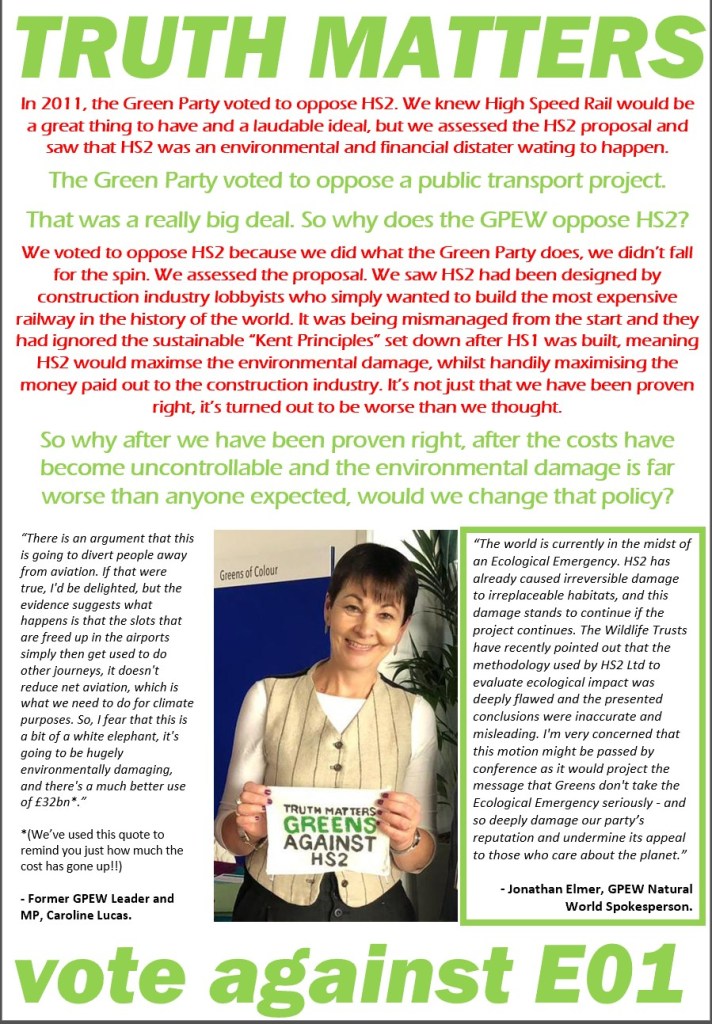
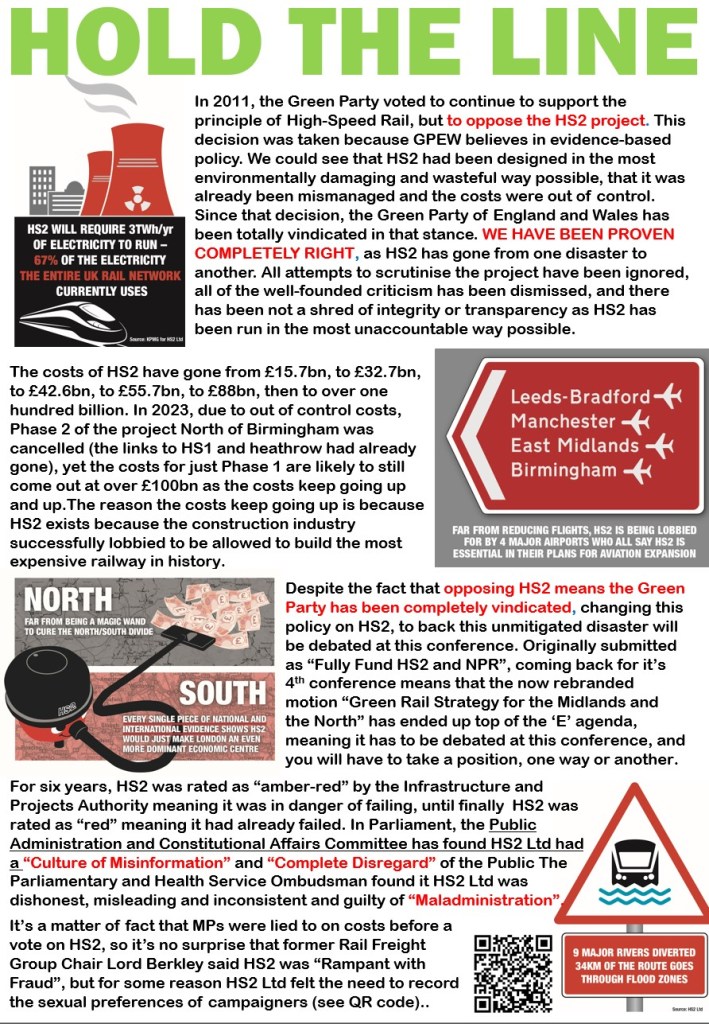
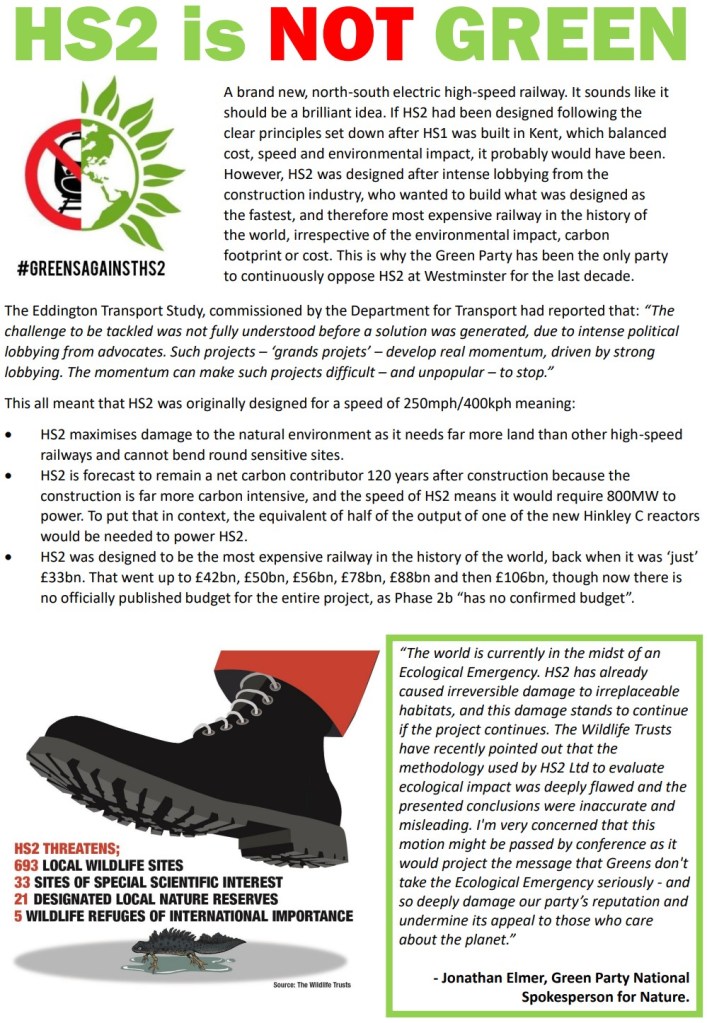
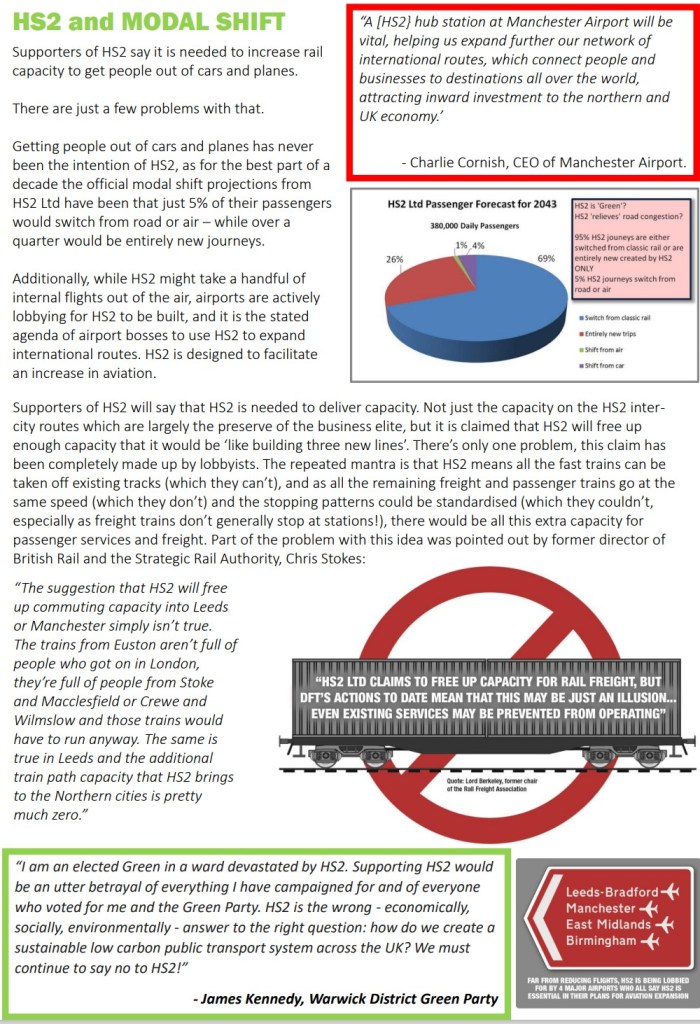
You can see that quote in one of our leaflets which are linked below. And we’d like you to share these as much as possible. Because we admit, we’ve not been as good as we should have been on social media. Because we’re weary of it, and there’s more than a few of us who have given up on some social media platforms, partially because of the constant circular arguments on social media about HS2.
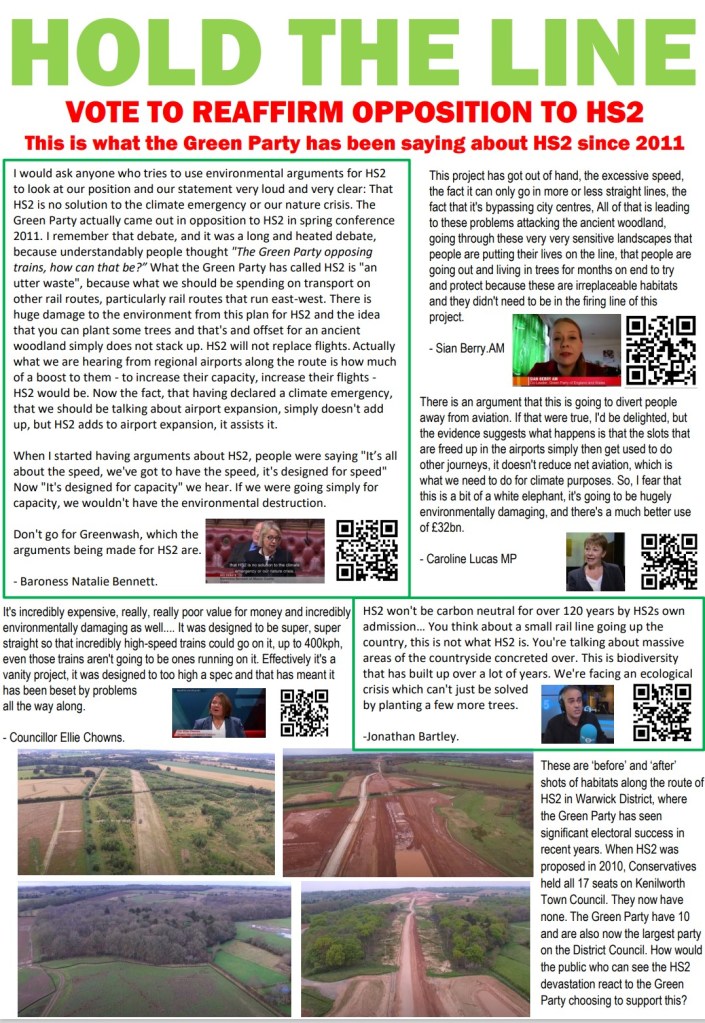
Here, we have the leaflets which we are giving out at conference. There are images below and here are the in PDFs for the new Truth Matters and Hold the Line. Also below is out policy, E17, the motion against HS2 which isn’t old enough to get debated, but it gives you the idea! All of the ideas…..
And here’s the new “Hold The Line”
As promised, there’s our policy, now ranked as E17:
At Spring Conference 2011, the Green Party passed policy TR11.3 to oppose HS2, which was to be reviewed if HS2 would reduce demand for transport, energy use, land take and CO2 emissions. On all of these tests, the case for HS2 has got worse and opposition should be renewed.
Policy:
In Record of Policy Statements (RoPS) add:
“The Green Party recognises that following the building of HS1, ‘The Kent Principles’ were drawn up to govern the building of any future high-speed railway line. These principles would seek to balance the needs of the environment, habitats, communities, and the railway. HS2 completely ignored these principles, and as such the design principles to build what was intended to be the fastest in Europe and for its length the most expensive railway in world history, have been set by the construction industry, seeking to maximise revenue. HS2 is a project designed with no sympathy for anything, other than profit and growth economics and as such must be opposed by The Green Party.”
“The Green Party should not approach high-speed rail, or any other proposed project which the Party might support in principle, in a political vacuum, without looking at the real-world implementations and the effects of projects and policies.”
“While the Green Party continues to support the idea of high-speed rail in principle, any such project must first and foremost be considered against the climate and ecological emergency, and demonstrate that it can be constructed in time, without adversely impacting the climate, ecological sustainability or associated economics. Specifically, the GPEW requires that any such project should be designed with clear constraints from the outset based on the ‘Kent Principles’. These should be: to run at a maximum of 200mph/320kph to minimise the impact to habitats, the natural environment and communities; to follow existing transport corridors where possible; to integrate into the existing rail network and have intermediate stations; and that any such project must be justified by a transport need and a clear ability to reduce carbon emissions, which must include a full assessment of all embedded carbon created during construction. Such projects should only be supported if they can also demonstrate that ticket prices will be affordable from the outset.”
“The Green Party notes that In 2020, the Wildlife Trusts, in conjunction with the Woodland Trust, RSPB and National Trust produced a report which concluded HS2 would risk the loss of, or significantly impact: 5 Wildlife refuges of international importance; 33 Sites of Special Scientific Interest; 693 Classified Local Wildlife Sites; 21 Designated Local Nature Reserves; 26 Large landscape-scale initiatives; 18 Wildlife Trust Nature Reserves; 108 Ancient woodlands; Other irreplaceable habitats such as veteran trees, wood pasture, old meadows; Extensive further areas of wider natural habitat; and that several scarce, protected and endangered wildlife species are under threat such as barn owls, white-clawed crayfish, willow tits and the lizard orchid. Rarities like dingy skipper may become locally extinct. The response from HS2 Ltd was that ‘The Wildlife Trust report was inaccurate and misleading. The fight against climate change needs to be based on facts’.”
“Furthermore, in 2023 the Wildlife Trusts reported that: HS2 Ltd had used inconsistent mapping and modelling; wild spaces and habitats were being undervalued; the benefits of new habitat creation was valued higher than existing established habitats; wildlife which was being trapped between construction areas was been ignored; many ponds had been only partially counted; huge numbers of trees and hedgerows which had been cut down were not counted at all; and the nature loss would be 7.9 times more than HS2 Ltd had accounted for. The response from the ‘High Speed Rail Industry Leaders Group’, (a vested interest lobbying group consisting mainly of the construction firms building HS2), was that the Wildlife Trust data was ‘Untested’ and ‘Unsurveyed’.”
“It is essential that the Green Party stands full square behind the Wildlife and Habitats policies of the party which have been passed at conference, and that the GPEW seeks to support the analysis of NGOs which exist for no other reason than to protect habitats, nature and wildlife in the face of corporate greenwashing from the construction industry. Failing to support such NGOs in such a situation would considerably damage the credibility and reputation of the Green Party, as well as ongoing working relationships with such organisations.”
“Through the ongoing work of Green Party members, we can demonstrate that HS2 Ltd have not assessed or mitigated all of the risks to groundwater in the Colne Valley (West London), or that raw drinking water quality is being protected. Works in the Mid Chilterns Chalk aquifer should be halted in line with current GP policy. Since the party originally passed policy on this matter, slurry pools and sinkholes have appeared above HS2 tunnelling works and the GPEW calls on the Government and regulators to uphold UK law and protect clean drinking water.”
“The construction industry has openly set up lobbying bodies, with the stated intention of dictating the political discourse around the HS2 project. This is one of the main reasons that HS2 had support from other Westminster parties from the outset of the project, as lobbyists seek to build up political momentum behind projects when they are little more than a politically appealing slogan. As the Green Party continues to become more of a political force, we must be wary of specifically targeted lobbying efforts concerning projects, especially those which are lacking in specific detail, which would benefit from the perception that they are environmentally sound.”
“All of the land which HS2 Ltd state they may require, whether it has been fenced-off or not, is currently covered by what is probably the largest single injunction ever seen in the UK. The Green Party believes that the criminalisation of being on such land represents an undemocratic attack on the right to peaceful protest, and it is high-handed actions like this, and the archaic way in which much of this land had been possessed by HS2 Ltd without even paying for it, which further demonstrates why the Green Party must oppose the HS2 project. “Many non-violent protesters have been arrested, and some jailed and the Green Party praises the commitment of non-violent climate campaigners, eco-warriors and habitat defenders who have spent months in camps, tree houses and tunnels, attempting to prevent the destruction to the natural environment which has been caused by HS2. These protests include the UKs longest ever tunnel protest in Swynnerton which lasted 47 days, and a Euston tunnel protest of 31 days.”
“Since 2010, the original HS2 budget of £33bn has spiralled out of control, whilst its functionality, notably the link to HS1 and the Channel Tunnel has been cut. The current situation is that 13 years after HS2 was first proposed, there is still no workable solution for how HS2 would get into Euston station, and whilst the Infrastructure and Projects Authority have rated the HS2 project as ‘amber-red’ for many years, in July 2023 they reported that Phase 1 and 2a had returned to a ‘red’ rating, meaning ‘Successful delivery of the project appears to be unachievable.’”
“We are in a climate emergency and HS2 does nothing but add carbon this decade, which is the all important decade to prevent runaway feed-back loops. In fact, due to the land take, loss of mature trees, and millions of tons of concrete and steel, when we factor in construction HS2 will never be carbon neutral. The way the carbon case concerning HS2 has been presented is of significant concern. Each of the three statutory carbon forecasts presented by HS2 Ltd to Parliament, which are prepared in line with BS EN 15978 and BS EN 15804 (Sustainability of construction works) and PAS 2080 (Carbon management in infrastructure), have shown that even on a 120-year forecast HS2 would not reach carbon neutrality due to the embedded carbon of the construction process, minimal modal shift, and the fact HS2 is intended to increase demand for travel. However, this has not stopped HS2 Ltd, away from these statutory frameworks, from expediently greenwashing HS2 as a ‘Zero Carbon Railway’ to the public. The case for HS2 is not supported by science. There are no independent assessments of carbon impact of embodied carbon, operational carbon, loss of trees and hedgerows, or scrutiny of the HS2 Ltd numbers of modal shift. It would be wrong to support any transport infrastructure project in the absence of these data.”
“GPEW policy TR244 states that the Green Party believes that long-distance service provision should not concentrate on high speeds where this will affect local service provision or take up an excessive amount of limited resources, and that the Green Party supports the principle of a new north-south high speed line which would reduce the number of short-haul flights within the UK. However, since the outset HS2 costs have spiralled, with no-one knowing what a ‘fully funded’ HS2 project would cost to build (let alone the cost of subsidising in operation), yet electrification projects have stalled, ticket offices are due to close across the country and rail workers are striking. It is abundantly clear that out of control spending on HS2 is already impacting on local service provision, long before HS2 is due to open.”
“The Green Party believes that HS2 represents business as usual economics, as it is an enclosed system which will not reduce car use or flying, and it has been specially designed to aid airport expansion. The Chief Executives of Birmingham and Manchester Airports have both gone on the record stating that they see HS2 as a mechanism to expand the number of international flights from their airports. Given the limited nature of HS2, it is far from certain that it would lead to a reduction in the number of internal flights.”
“Currently, £135m of taxpayers money is being spent on HS2 every week. The GPEW notes that at a time of cost of living crisis, when public sector pay is being cut in real terms, when the NHS is grossly underfunded, when education is grossly underfunded and many thousands of children rely on school meals for basic nourishment, squandering such vast sums on a project that has gone so awry is abhorrent.”
“We cannot build our way to a sustainable environment, and as such the GPEW reaffirms opposition to the HS2 project.”
In politics, there are no such things as certainties, and Green Party Conference 2023 is a great reminder not only of that. Looking at the agenda document ahead of the Green Party conference, there were several things that seemed to be certainties. One was that the motion to ban Greyhound Racing would surely sail through. Another was that the issue of HS2 was one of the most contentious issues on the order paper and there was no way to unite the party on this issue. But the changing tides at Brighton washed away both of those certainties as perfect examples of Green Party democracy in action.
Before the conference, I had been in a conversation about some who wanted to make sure that her proxy vote would be used to vote for the greyhound racing ban. While I understood her passion and sentiment, I struggled to explain why this was not necessary. There was no way this debate would go to a card vote. It would be a brave person to vote or speak against the idea that the Green Party should call for a ban on greyhound racing.
This was so much of a certainty that the press release was being prepared in advance, with the proposer being interviewed and photographs taken with her and her dogs outside the Brighton Centre. That made total sense. It would be one of the good news stories from conference, promoting the party’s stance on animal welfare, with some nice photos of beautiful animals thrown in. Whatever you think, this is exactly the sort of story the Green Party needs to break if it wants to set the narrative in the press.
And when it came to the debate, everything was going just fine, it was going to sail through.
But when it came to the debate, there was a brave person willing to speak against. Well sort of at least. He said that he didn’t want to speak against the motion, but point out an issue, a small and almost certainly unintended issue. The motion as it was written would delete the existing policy concerning horse racing, such as opposition to the use of the whip, and while it called for an end to animal exploitation for racing, it got rid of too much other good stuff.
The ban on greyhound racing had the support of the room, it had been one invigilator away from becoming policy. I don’t think anyone there will have seen a room change it’s mind so quickly, so completely, not to vote against the motion of course, but to refer it back, meaning the motion would have to be rewritten to avoid this unintended problem. The beauty of it was that this change of collective heart wasn’t down to some impassioned plea, but well-intentioned nitpicking, and this is something that truly sets the Green Party apart. Not only do most political parties minimise opportunities for the membership to set or question policy, but when they do, as soon as there had been an inkling that this might go the wrong way, a leading light of the party would have risen to give a speech filled with rhetoric and bluster to force the matter through on their coattails. After all, the press release was ready to go!
If what happened with Greyhound Racing seemed a shock, the idea that the conference would pass policy on HS2, pretty much unanimously in the space of ten minutes, without even having any debate would have left many observers on the floor, but that is exactly what happened.
After falling off the agenda twice at spring conference, HS2 was up for debate again this time, with the motion “Fund HS2 and Northern Powerhouse Rail” resubmitted and rebranded as “Green Rail Strategy for the Midlands and the North” now being flanked by a completely opposite motion to “Reaffirm Opposition to HS2”.
These debates had been bundled together so they would be heard consecutively at a time when it had been impossible to escape the issue of HS2. The telephoto lens which had captured a treasury official with a document outlining the cost savings for cancelling parts of HS2 had meant that conference was happening in the perfect storm of HS2. Rishi Sunak had chosen to stick his fingers in his ears over the speculation for three weeks, because nothing was going to stop him announcing that HS2 would not get to Manchester, in a former railways station, in Manchester.
Many of the arguments that Sunak made for cancelling HS2 echoed the reasoning that saw the Green Party come out in opposition to HS2 back in 2011. He didn’t quite go as far as former GPEW Sustainable Development Spokesperson John Whitelegg did when he labelled the then £17bn London to Birmingham line as “Socially Regressive, Environmentally Damaging and Bafflingly Irrational”, but he did say that the project was too expensive and more benefits to more people could be delivered more quickly for less money by improving the local transport infrastructure. It’s not easy to admit a Tory might have got something right, but we at least had the solace of being able to disagree with some of the alternative projects he thought the money should go on. How anyone can think that the entire rail network does not need to be electrified with in-cab signalling installed – improvements which can be delivered with next to no cost to the natural environment – is beyond many of us. The main reason from Sunak for the cancellation of HS2 was the spiralling costs, which if you had been listening to the lobbyist-driven rhetoric in the media at the time, is all my fault! OK, it was very much a team effort, but the line was that the costs had of HS2 went up because of all these crusty environmentalists and selfish nimbies living in Tory constituencies, causing all these new mitigations and tunnels on Phase 1. While I can’t take all the credit for what is at least a seventy-five billion pound cost escalation on HS2, I was Stop HS2 Campaign Manager for over ten years (in a Conservative area which has heavily gone Green in that period), so on that logic I’ve got to be personally responsible for a couple of billion of that? At least a couple of hundred million, surely?
The reality is that the environmental mitigations on Phase 1 are so far over-stated and minimal. Many of us have always been convinced that many of the post-construction environmental plans will never happen against a backdrop of significant cost-driven cuts to the project, and those tunnels had to be added because HS2 was terribly designed in the outset. Two tunnels in the Chilterns AONB were joined together because the deep cutting between them was unsustainable, but the main additional tunnelling was added in West London, where the original hastily draw up and clearly impossible plan had been for an overland route through Ruislip and Ealing.
The cancellation Phase 2 of HS2 was a missed opportunity for the Green Party, as without a policy debate due the same week, it would have been another opportunity for another massive dollop of “We told you so”, as the party could have drafted statements along the lines of “Well, it looks like we were right about this mess all along, what exactly did you expect? Maybe next time you should listen to us?”
While it is odd that the lobby to try and change the Green Party policy to support HS2 coincided with the widespread removal of habitats, the formation of protection camps and the considered opinion of wildlife NGOs that the environmental destruction is far greater than what HS2 Ltd have admitted, the reasons for debate on HS2 now are the same as they were when the policy to oppose the project was first passed in 2011. It is naturally hard for many in the Green Party to accept that any railway could be a bad thing, though unlike some of the people you will find on social media, there is surely no-one in the party itself who believes the implication of Green Party policy being anti-HS2, means that the party is somehow pro-road?
The costs of HS2 have gone up so uncontrollably for two reasons, complete mismanagement and corporate greed. Arguably these are one self-perpetuating and circular reason, as the more incompetent and ineffectual management is, the easier it is for construction companies, those whose lobbyists have been blaming residents and environmentalists others for the billions in cost over-runs they have been pocketing, to keep gold-plating HS2 and charging more and more for every job. Up until now they have been getting away with it, despite report after report showing HS2 was in trouble – most recently “unachievable” -, whistleblowers saying there was a deliberate agenda to hide true costs, and official minutes showing ministers knew this.
Until another vote on HS2 happens, no-one will know the size of the divide in the party on HS2 is, but there is clearly a divide, and many thought it would be impossible to unite the party on this issue. But there was something that everyone can agree on, and that is that what has happened with HS2 is quite simply a national scandal. Because whether you are ready to queue up for a ticket already, or you think HS2 should be buried deeper than the tunnels in the Chilterns, it impossible to disagree that what has happened to get the HS2 project to this point is the most godawful utter mess imaginable.
And you know what? We could all do with a bit of agreement on HS2, so an emergency motion was written to do the impossible and unite the Green Party on HS2, asking our parliamentary representatives to call for a public inquiry and a full-scale fraud investigation into this national scandal. And this time, there was time to discuss that emergency motion, in fact time was created to discuss it, with an extra ten minutes added to conference for a discussion. I say discussion, but there was no discussion, it was a high-speed motion dragging a high-speed amendment behind it. The amendment removed the call for a fraud inquiry, which given the Sunday Times splash since may have been shortsighted, but I have told one of our parliamentary representatives that she might still want to call for a fraud investigation anyway!
The other part of the amendment was to specify some of the things the inquiry should focus on. One of these was selling off the land – which legally has to be in the first instance to the people who owned it originally – which had already been bought for Phase 2. Noting that nowhere near all of the land needed had been bought, this was ostensibly a pro-HS2 amendment, but it wasn’t a big enough hill to let the whole motion die on, so it was accepted as friendly, especially as any form of debate would have run the motion out of time.
And not only did the motion go through without any debate, without anyone speaking against, save a question to ask if the fraud investigation could be put back into the text, but it went through in time and it gave the opportunity to show that compromise is possible, even when an issue seems unsurmountable, there can always be a way to find common ground in the Green Party. More than that, it provided a much needed end of conference lift, and everyone left a little bit happier. And although it might not have been the one that was intended, there was even the opportunity to send out one last press release!
e had initially hoped that the motion would have been heard at the end of Saturday and would therefore set the scene for the main debate the next day. The motion was specifically designed to be critical of HS2. Not the project, but the way it has been run, which it was felt would be something positive that even people who were for HS2 would admit and agree with
And not only did the motion go through without any debate, without anyone speaking against, save a question to ask if the fraud investigation could be put back into the text, but it went through in time and it gave the opportunity to show that compromise is possible, even when an issue seems unsurmountable, there can always be a way to find common ground in the Green Party. More than that, it provided a much needed end of conference lift, and everyone left a little bit happier. And although it might not have been the one that was intended, there was even the opportunity to send out one last press release!
e had initially hoped that the motion would have been heard at the end of Saturday and would therefore set the scene for the main debate the next day. The motion was specifically designed to be critical of HS2. Not the project, but the way it has been run, which it was felt would be something positive that even people who were for HS2 would admit and agree with.
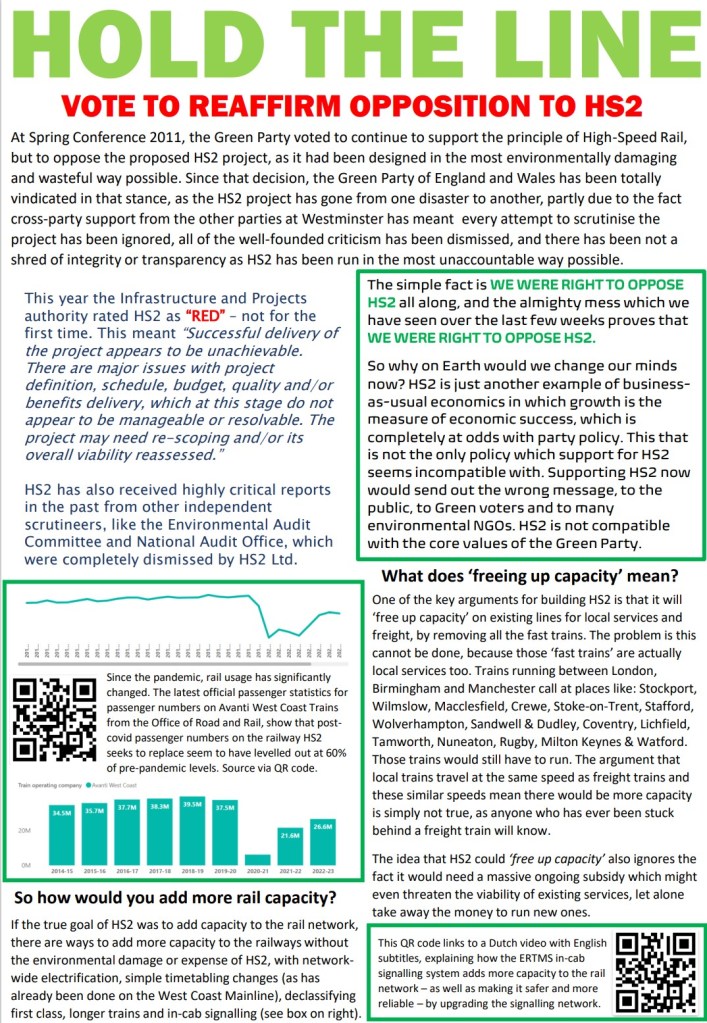
With two debates of HS2 – one to support the project and one to oppose it – likely to be heard at Green Party Conference on Sunday 8th October, we have produced another information leaflet ‘Hold the Line’. Images are below, and the PDF file can be found on this link.
The links to the videos from Green Party members can be found on our page What Greens (and others) have said about HS2, whilst the video explaining ERTMS, which is a way to add masses of capacity to the entire rail network at a fraction of the cost, with out any environmental damage – a truly Green solution to our future transport needs – is below.
The graphs shown above can be found on the ORR website. Please note, that if you do visit this site, the graphs are set to display figures for the entire rail network by default. The entire network is showing figures of about 70% of pre-pandemic levels, as while passenger numbers on some parts of the network have recovered , these are passengers doing short-distance inter-urban journeys in and around where they live. Avanti services on the West Coast Mainline are at 60% of their previous levels, showing a clear trend after the pandemic away from long-distance inter city commuting and business travel – exactly the thing HS2 was designed for.
And here’s that video from the Dutch. It’s in Dutch, but has English subtitles….
In spring 2023, a group of like-minded Green party activists came together to organise opposition to a motion submitted to the Green Party Conference entitled “Fully fund HS2 and Northern Powerhouse Rail”. After a lightning-quick mobilisation, that motion ended up running out of time -twice – for a full report click here.
As the motion did not get debated, we knew it would come back, but this time we would have the chance of being a little bit more prepared, meaning there would be an opportunity to submit a motion of our own. The pro-HS2 motion has been re-submitted exactly as it was – although the title has changed from “Fund HS2 and Northern Powerhouse Rail” to “Green Rail Strategy for Midlands and the North”, but we have got our own one in as well this time, and with the autumn conference a day longer than the spring one, this time it is almost certain that both motions will be debated and voted on, so our one is published below.
Motion Title:
Reaffirm opposition to HS2
Synopsis:
At Spring Conference 2011, the Green Party passed policy TR11.3 to oppose HS2, which was to be reviewed if HS2 would reduce demand for transport, energy use, land take and CO2 emissions. On all of these tests, the case for HS2 has got worse and opposition should be renewed.
Policy:
In Record of Policy Statements (RoPS) add:
“The Green Party recognises that following the building of HS1, ‘The Kent Principles’ were drawn up to govern the building of any future high-speed railway line. These principles would seek to balance the needs of the environment, habitats, communities, and the railway. HS2 completely ignored these principles, and as such the design principles to build what was intended to be the fastest in Europe and for its length the most expensive railway in world history, have been set by the construction industry, seeking to maximise revenue. HS2 is a project designed with no sympathy for anything, other than profit and growth economics and as such must be opposed by The Green Party.”
“The Green Party should not approach high-speed rail, or any other proposed project which the Party might support in principle, in a political vacuum, without looking at the real-world implementations and the effects of projects and policies.”
“While the Green Party continues to support the idea of high-speed rail in principle, any such project must first and foremost be considered against the climate and ecological emergency, and demonstrate that it can be constructed in time, without adversely impacting the climate, ecological sustainability or associated economics. Specifically, the GPEW requires that any such project should be designed with clear constraints from the outset based on the ‘Kent Principles’. These should be: to run at a maximum of 200mph/320kph to minimise the impact to habitats, the natural environment and communities; to follow existing transport corridors where possible; to integrate into the existing rail network and have intermediate stations; and that any such project must be justified by a transport need and a clear ability to reduce carbon emissions, which must include a full assessment of all embedded carbon created during construction. Such projects should only be supported if they can also demonstrate that ticket prices will be affordable from the outset.”
“The Green Party notes that In 2020, the Wildlife Trusts, in conjunction with the Woodland Trust, RSPB and National Trust produced a report which concluded HS2 would risk the loss of, or significantly impact: 5 Wildlife refuges of international importance; 33 Sites of Special Scientific Interest; 693 Classified Local Wildlife Sites; 21 Designated Local Nature Reserves; 26 Large landscape-scale initiatives; 18 Wildlife Trust Nature Reserves; 108 Ancient woodlands; Other irreplaceable habitats such as veteran trees, wood pasture, old meadows; Extensive further areas of wider natural habitat; and that several scarce, protected and endangered wildlife species are under threat such as barn owls, white-clawed crayfish, willow tits and the lizard orchid. Rarities like dingy skipper may become locally extinct. The response from HS2 Ltd was that ‘The Wildlife Trust report was inaccurate and misleading. The fight against climate change needs to be based on facts’.”
“Furthermore, in 2023 the Wildlife Trusts reported that: HS2 Ltd had used inconsistent mapping and modelling; wild spaces and habitats were being undervalued; the benefits of new habitat creation was valued higher than existing established habitats; wildlife which was being trapped between construction areas was been ignored; many ponds had been only partially counted; huge numbers of trees and hedgerows which had been cut down were not counted at all; and the nature loss would be 7.9 times more than HS2 Ltd had accounted for. The response from the ‘High Speed Rail Industry Leaders Group’, (a vested interest lobbying group consisting mainly of the construction firms building HS2), was that the Wildlife Trust data was ‘Untested’ and ‘Unsurveyed’.”
“It is essential that the Green Party stands full square behind the Wildlife and Habitats policies of the party which have been passed at conference, and that the GPEW seeks to support the analysis of NGOs which exist for no other reason than to protect habitats, nature and wildlife in the face of corporate greenwashing from the construction industry. Failing to support such NGOs in such a situation would considerably damage the credibility and reputation of the Green Party, as well as ongoing working relationships with such organisations.”
“Through the ongoing work of Green Party members, we can demonstrate that HS2 Ltd have not assessed or mitigated all of the risks to groundwater in the Colne Valley (West London), or that raw drinking water quality is being protected. Works in the Mid Chilterns Chalk aquifer should be halted in line with current GP policy. Since the party originally passed policy on this matter, slurry pools and sinkholes have appeared above HS2 tunnelling works and the GPEW calls on the Government and regulators to uphold UK law and protect clean drinking water.”
“The construction industry has openly set up lobbying bodies, with the stated intention of dictating the political discourse around the HS2 project. This is one of the main reasons that HS2 had support from other Westminster parties from the outset of the project, as lobbyists seek to build up political momentum behind projects when they are little more than a politically appealing slogan. As the Green Party continues to become more of a political force, we must be wary of specifically targeted lobbying efforts concerning projects, especially those which are lacking in specific detail, which would benefit from the perception that they are environmentally sound.”
“All of the land which HS2 Ltd state they may require, whether it has been fenced-off or not, is currently covered by what is probably the largest single injunction ever seen in the UK. The Green Party believes that the criminalisation of being on such land represents an undemocratic attack on the right to peaceful protest, and it is high-handed actions like this, and the archaic way in which much of this land had been possessed by HS2 Ltd without even paying for it, which further demonstrates why the Green Party must oppose the HS2 project. “Many non-violent protesters have been arrested, and some jailed and the Green Party praises the commitment of non-violent climate campaigners, eco-warriors and habitat defenders who have spent months in camps, tree houses and tunnels, attempting to prevent the destruction to the natural environment which has been caused by HS2. These protests include the UKs longest ever tunnel protest in Swynnerton which lasted 47 days, and a Euston tunnel protest of 31 days.”
“Since 2010, the original HS2 budget of £33bn has spiralled out of control, whilst its functionality, notably the link to HS1 and the Channel Tunnel has been cut. The current situation is that 13 years after HS2 was first proposed, there is still no workable solution for how HS2 would get into Euston station, and whilst the Infrastructure and Projects Authority have rated the HS2 project as ‘amber-red’ for many years, in July 2023 they reported that Phase 1 and 2a had returned to a ‘red’ rating, meaning ‘Successful delivery of the project appears to be unachievable.’”
“We are in a climate emergency and HS2 does nothing but add carbon this decade, which is the all important decade to prevent runaway feed-back loops. In fact, due to the land take, loss of mature trees, and millions of tons of concrete and steel, when we factor in construction HS2 will never be carbon neutral. The way the carbon case concerning HS2 has been presented is of significant concern. Each of the three statutory carbon forecasts presented by HS2 Ltd to Parliament, which are prepared in line with BS EN 15978 and BS EN 15804 (Sustainability of construction works) and PAS 2080 (Carbon management in infrastructure), have shown that even on a 120-year forecast HS2 would not reach carbon neutrality due to the embedded carbon of the construction process, minimal modal shift, and the fact HS2 is intended to increase demand for travel. However, this has not stopped HS2 Ltd, away from these statutory frameworks, from expediently greenwashing HS2 as a ‘Zero Carbon Railway’ to the public. The case for HS2 is not supported by science. There are no independent assessments of carbon impact of embodied carbon, operational carbon, loss of trees and hedgerows, or scrutiny of the HS2 Ltd numbers of modal shift. It would be wrong to support any transport infrastructure project in the absence of these data.”
“GPEW policy TR244 states that the Green Party believes that long-distance service provision should not concentrate on high speeds where this will affect local service provision or take up an excessive amount of limited resources, and that the Green Party supports the principle of a new north-south high speed line which would reduce the number of short-haul flights within the UK. However, since the outset HS2 costs have spiralled, with no-one knowing what a ‘fully funded’ HS2 project would cost to build (let alone the cost of subsidising in operation), yet electrification projects have stalled, ticket offices are due to close across the country and rail workers are striking. It is abundantly clear that out of control spending on HS2 is already impacting on local service provision, long before HS2 is due to open.”
“The Green Party believes that HS2 represents business as usual economics, as it is an enclosed system which will not reduce car use or flying, and it has been specially designed to aid airport expansion. The Chief Executives of Birmingham and Manchester Airports have both gone on the record stating that they see HS2 as a mechanism to expand the number of international flights from their airports. Given the limited nature of HS2, it is far from certain that it would lead to a reduction in the number of internal flights.”
“Currently, £135m of taxpayers money is being spent on HS2 every week. The GPEW notes that at a time of cost of living crisis, when public sector pay is being cut in real terms, when the NHS is grossly underfunded, when education is grossly underfunded and many thousands of children rely on school meals for basic nourishment, squandering such vast sums on a project that has gone so awry is abhorrent.”
“We cannot build our way to a sustainable environment, and as such the GPEW reaffirms opposition to the HS2 project.”




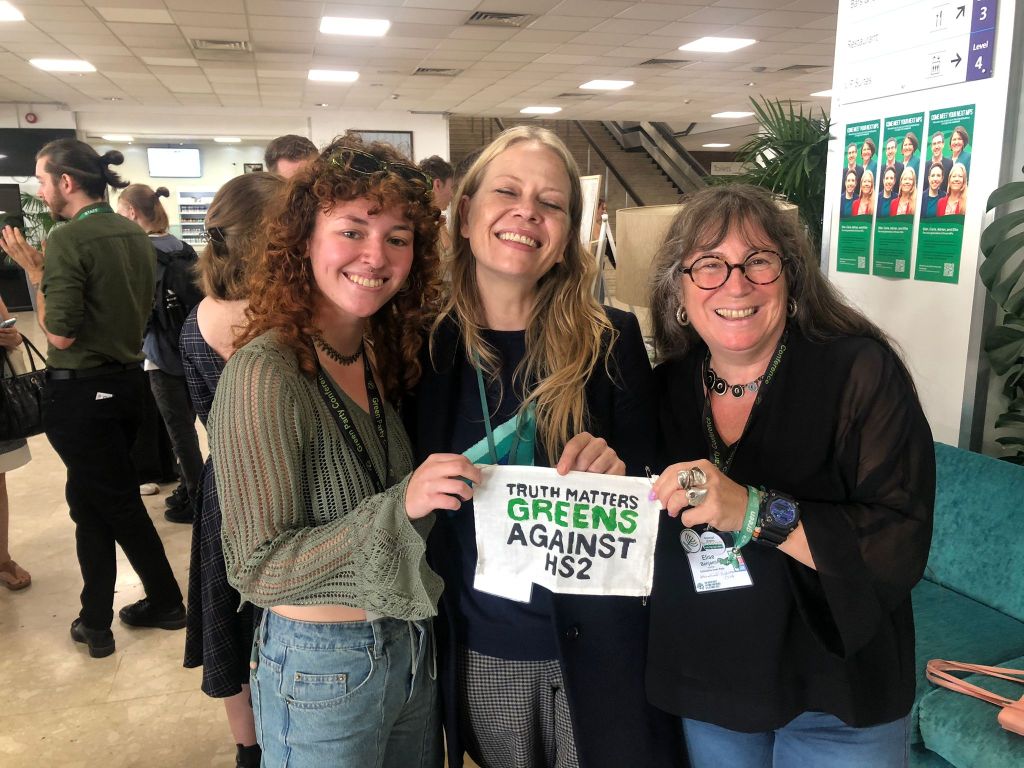
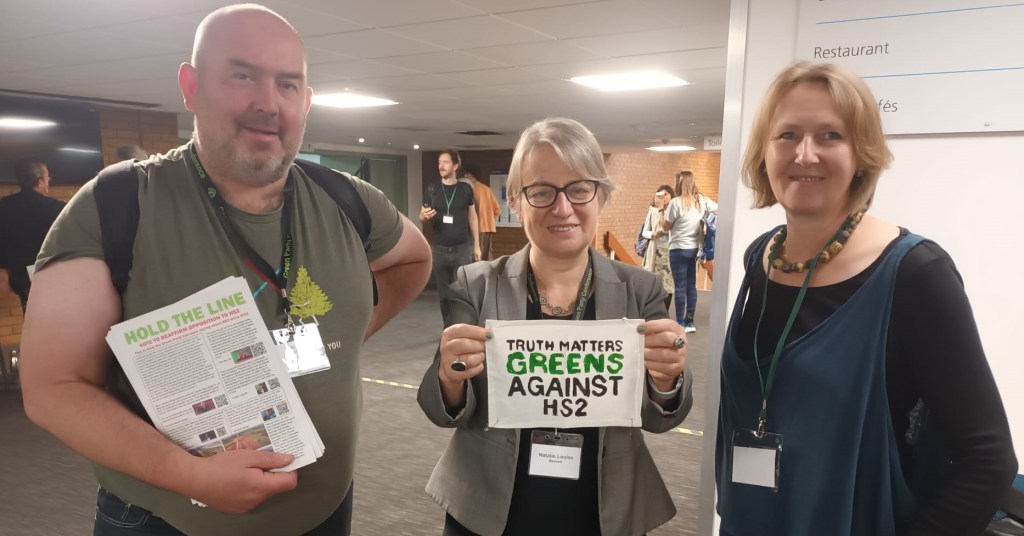



 Greens Against HS2